Casino No ID Verification in the UK: What It Means
 Available in GB

A practical explanation of sign-up, play and payment checks, including why “no ID” claims do not guarantee withdrawals without verification.
Table of Contents
- What “No ID” Means at an Online Casino
- Deposits, Bonuses and the Point at Which Checks Begin
- Slots and Real-Money Play Without an ID Check
- Offshore Licensing, UK Access and GamStop
- Free Spins Do Not Remove Verification Conditions
- Withdrawals: Verification, Approval and Limits
- Assessing “Best” No-ID Casino Claims
- Free Spins on Slots: The Verification Caveat
- Paying by Mobile: Deposit Is Not Withdrawal
- Crypto Cashouts and the Time to Settlement
- Casino Sites
What “No ID” Means at an Online Casino
“No ID” can describe a casino that does not ask for identity documents during registration. It does not, by itself, mean that the operator will never verify a player’s identity. Those are different claims: one concerns when a check happens; the other suggests that no check happens at all.
For online gambling businesses in Great Britain, the requirement is clear: a customer’s age and identity must be verified before they gamble. A registration form that accepts basic details without requesting a passport or other document does not remove that obligation. It may simply mean that verification takes place later, or is completed through an automated process rather than a manual document review.
This distinction matters when comparing UKGC-licensed casinos with sites operating from overseas. A UKGC-licensed casino almost always requires verification at some stage. The timing and method can differ, but a claim of “no ID needed” should not be read as evidence that identity checks have been waived. The phrase may refer only to the initial sign-up experience.
No document upload is not the same as no check
Identity verification does not always begin with a request to upload a photograph of a document. An operator may use electronic checks, sometimes described as eKYC, to verify information automatically. If that process confirms the required details, there may be no immediate request for a photo ID. If it does not, the operator may ask for documents or other information.
The practical result is that “no photo ID” can mean “no document upload at this point”, rather than “no identity verification”. A customer may complete registration without seeing a document request and still encounter a check before being allowed to gamble. The absence of a visible request is not proof that the account has passed verification.
The wording also leaves important questions unanswered. Does “no ID” refer only to the registration form? Is the claim about a particular payment method, or about the whole account? Does the operator use electronic checks? A headline rarely answers these points. The terms governing account verification are more informative than the label.
Casino Sites Not Registered with GamStop in the UK
For a search such as “online casino no ID verification UK”, the key issue is therefore not whether a site asks for a document at sign-up. It is whether the operator verifies age and identity before real-money gambling. A process that postpones a document request is not equivalent to a process that removes the requirement.
UK-licensed and offshore sites are not the same category
A UKGC-licensed casino operates within the British licensing framework. It must meet the requirement to verify a customer’s age and identity before gambling. Some checks may be completed without a customer manually sending documents, but that does not turn the account into an unverified one. The operator remains responsible for confirming the required details.
Offshore casinos may use different account procedures. In this market, the difference between UKGC sites and offshore sites is often the timing of checks: a site may allow account activity before requesting full identity documents, then conduct checks later. That is a delay in verification, not evidence that verification will never occur. Offshore operators may also use automated checks, even where their sign-up process does not request full documentation.
Non-Gamban Casinos in the UK: What It Means
The label “no-KYC casino” can therefore describe a limited stage of the customer journey rather than a permanent exemption from checks. “KYC” refers to identity checks, but marketing language does not define what the operator will require in practice. A site may call itself no-KYC while retaining the ability to request identity information when it considers that necessary. The wording is broad; the operator’s actual process is the relevant detail.
This is especially important where a site presents itself as a no-ID option for British players. A lack of a document request at registration should not be mistaken for the UKGC standard, nor should it be treated as proof that no identity checks apply. A UKGC-licensed casino must verify before gambling, whether that happens through electronic checks or a request for documents.
The phrase “online casino with no ID check” is thus too imprecise to settle the question on its own. It can mean no document upload during registration, an automated verification process, or a later request for evidence. Those meanings have different consequences. The only sound reading is to distinguish the point at which a check happens from whether the operator verifies identity at all.
A claim of “no ID needed” may refer only to the initial sign-up experience and is not evidence that identity checks have been waived.
Deposits, Bonuses and the Point at Which Checks Begin
A deposit screen can appear before an identity check, but that sequence does not establish that a casino has waived verification. The relevant distinction is between when a site asks for documents and whether it completes the checks required before gambling. A payment going through answers only whether the deposit was accepted.
UK-licensed casinos often complete full KYC before the first deposit. That can mean the account is checked before funds are added, rather than at the point a withdrawal is requested. The process may involve information supplied during registration and further checks where needed. A smooth sign-up or an accepted payment is not a substitute for the operator’s age and identity controls.
For online gambling businesses in Great Britain, age and identity must be verified before a customer gambles. That requirement is not conditional on whether the game is a slot, whether a bonus has been claimed, or whether the first deposit is small. A no-ID check casino claim therefore needs to be read as a claim about the timing or visibility of checks, not evidence that verification is unnecessary.
Deposit accepted does not mean checks are complete
Some non-UK registered casinos delay full KYC until later in the account journey, commonly until the first cashout. This timing can make registration and depositing feel less demanding. It does not mean the operator will never ask for documents, nor does an accepted deposit confirm that the account has passed every check.
Casino Sites and Safety: Licensing and Access
Offshore operators may also use electronic KYC, or eKYC, to run checks automatically. A customer might not be asked to upload documents at sign-up if available information can be checked electronically at that point. Automated screening can still be a verification process; it is simply less visible than a request for files. If the system cannot confirm details, or if another review is needed, the operator may ask for more information.
This is why “no ID casino sites” and “no ID check casino” are not precise descriptions of a single account process. One site may ask for documents before a deposit, another may run electronic checks behind the scenes, and another may postpone a request. The apparent ease of entry says little about what the account will need to provide later.
There is also a legal distinction behind the timing. Operators offering real-money gambling to customers in Great Britain must hold a UK Gambling Commission licence and verify age and identity before gambling. A non-UK registered operator does not become a UK-licensed casino because its website accepts a British payment or displays a registration form for UK residents. If it is serving the British market, the licensing requirement still matters. A delayed document request should not be mistaken for permission to gamble before required checks are complete.
A bonus is an offer, not a verification waiver
The same distinction applies to a no-deposit bonus or a no-deposit offer advertised alongside a casino account. “No deposit” describes the funding condition of the promotion; it does not describe the identity-check condition. A bonus can be available without an initial payment and still be subject to account checks, age requirements and the promotion’s own terms.
A no-deposit bonus describes the funding condition of a promotion, not the identity-check condition; it remains subject to account checks and age requirements.
The headline wording also does not settle whether an offer can be activated, used or converted into withdrawable funds without further review. Eligibility conditions may apply, and the operator’s terms govern how the promotion works. A claim for a no-ID casino no-deposit bonus in the UK should therefore be assessed separately from the question of when the casino verifies an account. The two conditions are not interchangeable.
An offer that appears on screen before a document request is not proof that verification has been waived. It may reflect the site’s registration flow, an automated check, or simply the point at which the account journey has reached. Promotional language describes the offer; it does not override the age and identity requirements that apply before gambling in Great Britain.
For a deposit decision, the useful distinction is between an account that has passed checks and one that has merely accepted funds. For a bonus decision, the useful distinction is between the offer’s funding condition and the account’s verification status. Neither a successful deposit nor a visible promotion establishes that identity checks will not follow.
Slots and Real-Money Play Without an ID Check
A slot game does not create an exception to the identity rules for online gambling in Great Britain. Before a customer gambles, the operator must verify both age and identity. That applies to real-money slots just as it applies to other forms of online gambling. The format of the game, the size of a stake and the fact that play happens through a slot interface do not remove that requirement.
Non-GamStop European Casinos: UK Rules Explained
For a real-money session, “no ID needed” cannot mean that a UK-licensed casino is free to let an unverified customer gamble. A site may describe its registration process as simple or say that documents are not requested immediately, but that wording does not change what must happen before gambling begins. The relevant question is not whether a document upload appears on the first screen. It is whether age and identity have been verified before real-money play is allowed.
That distinction matters because a slot lobby can make access look like the whole process. Games may be visible, and an account may be open, but neither fact establishes that the operator has completed the required checks. An account is not permission to gamble. For a customer considering slots with real money, the legal condition sits before the first wager, not somewhere after a session has already taken place.
The rule is about the customer and the act of gambling, not about a particular slot title or provider. There is no separate class of real-money slot that can be played without age and identity verification because it is labelled “instant”, “quick” or “no ID”. Those descriptions concern the operator’s presentation of its service; they cannot disapply the requirement imposed on an online gambling business.
This also puts “best slots with no ID needed” claims in context. A ranking or game selection cannot establish that identity checks have been waived. Nor does a collection of slots become exempt because each game is accessed from the same casino account. The operator’s duty applies at the point the customer is to gamble. A list of games, however polished, is not evidence that real-money play may begin without verification.
UK Compliance
If an operator allows real-money slot play before confirming age and identity, it is a failure to meet the requirements for online gambling businesses in Great Britain.
The same logic applies when a promotion is attached to slots. A no-deposit label, a bonus description or free spins may change the commercial terms of an offer, but it does not turn real-money gambling into an activity exempt from age and identity checks. Those terms need to be assessed separately from the permission to gamble. The slot itself does not decide whether the customer has met the verification condition.
It is useful to keep three states separate: seeing a game, holding an account and being permitted to gamble. They can appear close together on a screen, but they are not interchangeable. Only the last state involves real-money play, and the operator must have verified age and identity before allowing it. A site’s claim that slots are available without an ID check should therefore be read narrowly, not as proof that the legal requirement has disappeared.
For players aged 18 and over, online gambling in the UK is legal only when the operator holds a UK Gambling Commission licence. That local licence framework and the pre-gambling verification duty work together: the licence governs the operator’s authority to serve the market, while the check confirms that the customer meets the age and identity requirements. A casino’s slot catalogue cannot substitute for either condition.
The practical result is plain. There are no UK real-money slots that acquire a special no-verification status simply because they are slots. If an operator allows gambling before confirming age and identity, the issue is not a special feature of the game; it is the operator’s failure to meet the requirement. “No ID needed” may describe a claim about a process, but it cannot make unverified real-money slot play compliant.
Non-GamStop Curaçao Casinos and UK Rules
Offshore Licensing, UK Access and GamStop
A casino’s overseas licence and its permission to serve customers in Great Britain are separate matters. An operator may hold a licence from a regulator outside the UK, but that licence is not a UK Gambling Commission licence. Remote gambling businesses offering services to people in Great Britain are required to hold the relevant UKGC licence, regardless of where they are based.
This distinction matters when a site advertises itself as a no-ID casino in the UK. “Offshore” describes where the operator is licensed or regulated; it does not establish that the casino is authorised to serve the British market. Nor does the phrase “no ID” alter the operator’s licensing position. A lack of UKGC oversight is a regulatory difference, not a substitute form of UK approval.
UK residents may access casinos licensed overseas where the operator is not illegally targeting the UK market. That is not the same as saying every overseas-licensed site is entitled to operate here. The operator’s conduct and its obligations in relation to the British market remain relevant. An overseas licence governs the operator under that regulator’s system; it does not confer a UKGC licence.
What non-GamStop means
GamStop is the UK’s national online self-exclusion scheme. UK-licensed gambling operators must integrate with it. A site that is not registered with GamStop is therefore outside that UKGC-linked system and does not hold a UK Gambling Commission licence.
That definition is narrower than some marketing suggests. Non-GamStop describes the site’s relationship to the scheme; it does not certify the operator’s standards, settle whether the site may lawfully target UK customers, or establish that the business conducts no checks. It also does not mean that a casino is independent of all regulation: an offshore operator may be regulated under an overseas licence, but that is not UK oversight.
What is a non-GamStop casino?
A site that is not registered with GamStop is outside the UKGC-linked system and does not hold a UK Gambling Commission licence.
The practical distinction is consequently about regulatory coverage. At a UKGC-licensed casino, GamStop integration is part of the operator’s obligations. At an offshore casino, there is no obligation to participate in GamStop. The scheme’s exclusion does not extend to those sites, so a person who has self-excluded through GamStop should not treat a non-GamStop casino as a permissible alternative. The gap in coverage is a limitation of the scheme, not a route around an exclusion.
Licence status and access are different questions
A site loading in a browser does not prove that it is authorised to provide gambling services in Great Britain. Equally, an overseas licence alone does not answer whether the operator is illegally targeting the UK market. These are separate questions: whether the operator is licensed by a regulator, and whether it is entitled to serve customers in this jurisdiction.
For a claim of UK regulation, the relevant licence is a current UK Gambling Commission operating licence. An offshore licence should be understood as an overseas authorisation, not as equivalent UK approval. The distinction is especially important where “no ID” wording is used to make a site appear less constrained: the phrase says nothing reliable about the operator’s UK status or its connection to GamStop.
Non-UK-Regulated Casinos: Rules and Protections
In short, “non-GamStop” identifies the absence of UKGC licensing and GamStop integration. It does not, by itself, establish lawful UK-market operation, remove regulatory conditions, or make a site suitable for someone relying on self-exclusion.
Free Spins Do Not Remove Verification Conditions
A free-spins offer may be presented alongside claims such as “no ID required”, but the promotion does not change the operator’s obligations. In Great Britain, an online gambling business must verify a customer’s age and identity before that customer gambles. Free spins are still a way to gamble, even when no deposit is attached to the offer.
That makes the wording important. “No documents at registration” describes a point in the account process; it does not mean that identity checks have been waived before play. A claim that spins are free, or that they do not require a deposit, concerns the offer’s price to the customer. It does not establish that the customer can use them without age and identity verification.
What the offer does—and does not—say
Promotional language can compress several separate conditions into a short label. “Free spins” describes the promotional mechanic. “No deposit” indicates that the offer does not require a qualifying deposit. “No ID” may refer to a particular stage, or may be an imprecise marketing claim. None of those phrases, on its own, confirms that a casino has no verification process.
The relevant distinction is between receiving an offer and being permitted to gamble with it. A promotion can appear on a page before an account is fully checked; that appearance is not evidence that the checks will not be required before the spins are used. Nor does a claim about free play create an exception to the age-and-identity requirement.
This applies whether the offer is described as free spins with no deposit and no ID, or simply as a no-ID free-spins promotion. Changing the order of the words does not change the underlying condition. The operator must verify age and identity before gambling takes place.
Free spins are still a way to gamble; calling them "free" does not create an exception to the requirement to verify age and identity before play.
The real-money boundary
Free spins can also be described as a route to online casino play without an ID check. That description is unreliable if it suggests a customer may gamble first and avoid verification altogether. The regulatory requirement is tied to gambling, not to whether the customer funded the account with their own money.
A promotion might distinguish between the spins themselves and any later use of winnings, but that distinction does not remove the check required before gambling. Promotional terms cannot replace the operator’s verification obligation. If an offer is available only after an account action, its wording still cannot establish that identity checks are unnecessary.
The same reasoning applies to a crypto casino advertising free spins without ID. The payment method and the promotional label do not alter the age-and-identity rule. A claim about crypto funding is not proof that a customer can gamble without verification.
For UK-facing offers, the useful question is therefore not whether the spins are labelled “free”, but what the no-ID wording actually promises and at what stage. If it implies that age and identity will never be checked before gambling, it conflicts with the requirement applying to online gambling businesses in Great Britain. If it refers only to registration, the phrase is narrower than it first appears.
The promotional value is conditional on being able to use the spins. Without verification before gambling, the offer cannot lawfully serve as a way around the checks. “Free” describes the price of the spins; it does not purchase an exemption from identity controls.
Withdrawals: Verification, Approval and Limits
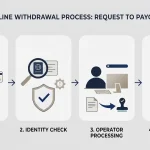
A withdrawal request is not necessarily the point at which money moves. It starts a process with two separate stages: the casino must approve the request, then the chosen payment method must settle it. A delay at either stage can leave the balance unavailable, but the cause is different in each case.
Anjouan Casino Licence in the UK: What It Means
At the approval stage, an operator may ask for identity documents before releasing a first withdrawal. Offshore casinos commonly place this check at cashout, and non-GamStop marketing that promises “no-KYC” does not establish that documents will never be required. In practice, the label may describe the registration process rather than the conditions for payment. A request for verification can therefore arrive after a balance has been built up.
The distinction matters because an account balance and an approved withdrawal are not the same thing. Until the operator has completed its checks and authorised the request, the payment has not necessarily entered the settlement stage. Supplying documents does not itself establish that a withdrawal has been approved; it is one part of the operator’s review.
After approval, settlement depends on the payment route and its processing. That stage should not be confused with the casino’s review: a payment service cannot settle a request that the operator has not released. Where a withdrawal is taking longer than expected, the useful distinction is whether it is still awaiting casino approval or has already been sent for payment. The terms for withdrawals should explain how the operator handles requests and which payment methods are available for cashing out.
Limits can affect the amount released as well as the timing. A specialist review has reported monthly withdrawal caps at offshore casinos; this should be treated as an operator-specific condition, not a rule that applies to every site. If a cap is lower than the amount requested, the balance may be paid in stages rather than in one transfer. For a large win, that can extend the period before the full amount reaches the account, even where each individual request is approved.
Do
- Check the operator’s withdrawal conditions
- Verify the available cashout methods
- Check for any specific withdrawal caps
Don’t
- Assume a “no-KYC” label waives all checks
- Mistake a deposit method for a withdrawal route
- Rely solely on advertised settlement speeds
The relevant calculation is therefore not simply the advertised withdrawal speed. It is the amount the operator will approve at a time, the applicable limit, and the time needed for the payment route to settle each approved amount. A fast settlement method does not remove a casino-side cap, and a generous limit does not eliminate verification. Those are separate terms.
A “no ID withdrawal” claim should be read against the withdrawal conditions, not as a promise that identity checks are waived. If the terms reserve the right to request documents, the practical outcome may be a verification review before approval. That can apply even when the account was opened without a document upload. The cost of the label is not a fee; it is uncertainty over when the check will occur and whether a requested payment can proceed before it is completed.
For any withdrawal, the status of the request and the operator’s stated conditions matter more than the “no-KYC” description. Approval, settlement and withdrawal limits each govern a different part of access to the money.
Assessing “Best” No-ID Casino Claims
For a UK search focused on casinos advertised as requiring no ID verification, check the operator’s actual verification terms before signing up. The details available here are limited, so treat the payout information as a reference rather than confirmation of a no-ID policy.
1. Amunbet
Payout speed: 1-3 business days Amunbet has a stated payout speed of 1–3 business days. This information does not confirm whether ID verification is required.
2. NightLuck
Payout speed: 1-3 business days NightLuck has a stated payout speed of 1–3 business days. This information does not confirm whether ID verification is required.
3. WinBeast
Payout speed: 1-3 business days WinBeast has a stated payout speed of 1–3 business days. This information does not confirm whether ID verification is required.
4. Britsino
Payout speed: 1-3 business days Britsino has a stated payout speed of 1–3 business days. This information does not confirm whether ID verification is required.
5. EvoSpin
Payout speed: 1-3 business days EvoSpin has a stated payout speed of 1–3 business days. This information does not confirm whether ID verification is required.
6. BeOnBet
Payout speed: 1-3 business days BeOnBet has a stated payout speed of 1–3 business days. This information does not confirm whether ID verification is required.
7. Zombillion
Payout speed: 1-3 business days Zombillion has a stated payout speed of 1–3 business days. This information does not confirm whether ID verification is required.
8. SlotoSport
Payout speed: 1-3 business days SlotoSport has a stated payout speed of 1–3 business days. This information does not confirm whether ID verification is required.
9. SpinFormula
Payout speed: 1-3 business days SpinFormula has a stated payout speed of 1–3 business days. This information does not confirm whether ID verification is required.
10. x3bet
Payout speed: 1-3 business days x3bet has a stated payout speed of 1–3 business days. This information does not confirm whether ID verification is required.
A “best” label is not evidence that a casino has a particular licence, offers UK regulatory protection or will waive identity checks. The useful starting point is the operator’s legal status, not the wording on a comparison page.
For a site serving customers in Great Britain, the relevant check is whether the operator holds a current UK Gambling Commission licence. The Commission’s public register allows the stated licence to be checked against the operator. A logo or a licence number printed on a casino page is only a claim until it matches the regulator’s record.
Some sites marketed as no-ID casinos are licensed overseas rather than by the UK Gambling Commission. That difference matters: an overseas licence does not place an operator under UKGC oversight. UK residents may play with an overseas-licensed casino where the operator is not illegally targeting the UK market, but that does not make it a UK-licensed casino or give it the same regulatory status.
The phrase “no ID” also needs careful interpretation. It can describe a registration process without an immediate document request; it does not establish that identity checks will never happen. A ranking based on the promise alone therefore measures marketing language, not the amount of verification or the certainty of a payout.
A sound assessment records the issuing regulator and confirms the licence on its own register. It then treats any claims about avoiding checks as unproven unless the operator’s terms explain when verification can be required. The absence of UKGC oversight should be recorded plainly rather than softened into a vague claim that a site is “internationally regulated”.
There is no defensible universal winner among “best no-ID casinos” on that basis. Without a verified licence and clear terms, the label leaves the main conditions unresolved. A neat ranking cannot repair that gap; it can only make the gap look better formatted.
Free Spins on Slots: The Verification Caveat
A slot promotion described as “free spins with no ID verification” can refer to the offer’s entry conditions, but it does not remove the checks required before gambling. The UK Gambling Commission requires online gambling businesses to establish a customer’s age and identity before that person gambles. Free spins are still a way to play; calling them free does not create an exception.
Verification Requirement
The absence of a document request at registration does not override the legal obligation to verify age and identity before gambling begins.
The distinction matters when an offer appears to allow access without documents. A registration page may not ask for uploaded identification immediately, or an operator may conduct checks electronically. Neither point establishes that verification has been waived. The relevant question is whether the customer’s age and identity have been verified before the spins are used for gambling.
Promotional wording also needs to be separated from the underlying eligibility rules. “No ID” might describe what is requested at sign-up, rather than what the operator will require before play. If checks are outstanding, the free-spin balance is not evidence that the account has passed them. An offer cannot override the operator’s obligation.
For UK-facing slot promotions, the practical test is therefore not whether the spins carry a deposit cost, but whether the required age and identity checks are complete before gambling begins. A claim of free spins without an ID check should not be read as permission to play anonymously. The wording may describe a step that has not yet occurred; it does not change the point at which verification is required.
Paying by Mobile: Deposit Is Not Withdrawal
Paying by mobile can make a deposit feel like a charge on a phone bill, but it does not create a matching route for taking money out. Specialist reviews of offshore payment options describe Boku and similar services as deposit-only. The distinction matters: a payment method may appear in the cashier for funding an account without being available for withdrawals.
That leaves two separate transactions. The mobile payment sends funds to the casino; any later payout must use a method the operator supports for cashouts. A mobile number or phone-bill charge is not, by itself, a withdrawal destination. The deposit option therefore cannot establish that winnings can be returned through the same channel.
No Account Casino UK: How It Works and What to Check
The “no ID” part of a mobile-casino claim does not change this payment limitation. Mobile billing describes how money enters an account, not whether identity checks have been waived. Where an offshore operator permits play before completing checks, that timing still does not turn Boku into a cashout service.
The practical calculation is straightforward: a deposit method has value only alongside a workable withdrawal route. Before treating mobile payment as a complete banking option, the casino’s terms need to be read for its separate cashout methods and any conditions attached to them. If mobile is listed only under deposits, the account has no mobile withdrawal route.
Crypto Cashouts and the Time to Settlement
A cryptocurrency cashout has two separate stages: the casino must approve the withdrawal, then the payment must settle through the relevant network. The time quoted for a crypto transfer is not necessarily the time from submitting a request to receiving funds. If the casino has not approved the request, the settlement clock has not yet started.
A specialist review of offshore operators reports crypto withdrawal processing in a window of one to six hours. That figure should be treated as a reported estimate, not a promise applying to every operator or transaction. The review’s window does not establish how long casino approval takes, and the total wait can therefore be longer.
Using Bitcoin or Ethereum does not remove identity checks. A no-KYC label may describe when an operator asks for documents, rather than a permanent exemption from verification. Crypto changes the payment route; it does not change the operator’s ability to require checks before releasing a withdrawal. For British customers, a cryptocurrency cashout at an offshore casino should not be confused with the protections of a UK Gambling Commission-licensed service.
The useful comparison is therefore between the operator’s approval process and the separate settlement estimate, not between crypto and an assumed instant payout. Terms should state whether a published processing window begins only after approval. Without that distinction, a short transfer estimate can make the full withdrawal process look shorter than it is.
Casino Sites

Anjouan Casino Licence in the UK: What It Means
Anjouan licensing has a limited territorial scope and does not meet the UK authorisation requirement...

Casino apps in the UK: licensing and mobile play
The guide compares installed apps with mobile sites and explains licensing checks, account controls, withdrawals,...

Foreign Casinos for UK Players: Rules and Risks
The guide explains licensing status, bonus conditions, payment checks, withdrawal routes and protections that may...

International Casinos for UK Players: What to Know
The guide distinguishes UKGC authorisation from offshore licensing and examines access, payouts, bonus terms, crypto...

UK Mobile Casinos That Accept Phone-Credit Payments
Phone-credit deposits run through a network account or prepaid balance, distinct from using a mobile...

Best Offshore Casino Sites: UK Rules and Risks
A practical guide to UK licensing, payment and bonus conditions, identity checks, and risks that...

Best Offshore Casinos for UK Players: What to Check
Offshore casinos may accept UK customers without UKGC approval, leaving players outside some protections of...

British Casinos Not on GamStop: How Exclusion Works
GamStop exclusions apply to participating UKGC-licensed establishments, while other sites may operate outside that framework...

Casino Sites Not Registered with GamStop in the UK
See how UKGC licensing defines GamStop’s reach and what to consider when assessing casinos outside...

No ID Verification Withdrawal Casinos in the UK
The phrase “no ID verification” can describe delayed checks, while UK gambling businesses must verify...

Casino Without a UK Licence: Rules and Risks
A foreign licence does not mean UKGC oversight, and the difference can affect player protections,...

Casinos That Bypass GamStop: UK Access and Risks
The guide distinguishes UK self-exclusion protections from offshore licensing, access and bonus conditions. What a...

Curacao Casino Licences and UK Player Protections
A licence identifies a regulatory framework, but does not show whether a casino accepts UK...

Gibraltar Casino Licence in the UK: What It Means
A Gibraltar licence identifies the operator’s regulator, while UK-facing service in Great Britain requires separate...

Jackpot Mobile Casinos in the UK: Pool Rules
Jackpot games can use different pool structures, so the prize amount alone does not explain...

Merkur Casino Online UK: Games, Login and Checks
Merkur games, casino branding and account access can refer to different things, so operator status...

Most Trustworthy Online Casinos in the UK: Licence Rules
A practical framework for checking licensing, market boundaries, bonus terms and verification before assessing a...

No Account Casino UK: How It Works and What to Check
A no-account label can mean a shorter sign-up journey, but it does not remove identity...

Non-Gamban Casinos in the UK: What It Means
Gamban is a blocking service; GAMSTOP applies self-exclusion across participating licensed gambling websites and apps...

Non-GamStop Curaçao Casinos and UK Rules
A Curaçao licence claim, permission to serve Great Britain and participation in UK self-exclusion arrangements...

Non-GamStop European Casinos: UK Rules Explained
The “Non-GamStop” label describes a site outside the scheme, but does not establish its licence...

Non-UK Licence Casinos: What the Licence Means
Licensing jurisdiction, verification rules and withdrawal terms shape what oversight and player recourse may apply....

Non-UK-Registered Casinos: Licensing Explained
A foreign licence is not UKGC approval, and differences in rules can affect access, payments,...

Non-UK-Regulated Casinos: Rules and Protections
The guide distinguishes UKGC oversight from licences issued elsewhere and outlines the limits of player...

Non-UKGC Licensed Casinos: Rules and Risks
A guide to the difference between UKGC authorisation and offshore licences, including bonus conditions, payment...

Malta MGA Licence for UK Online Casinos: What Applies
A Malta operating licence is separate from permission to offer remote real-money gambling in England,...

Online casino no registration in the UK: what it means
Browser access can remove software installation, but it does not establish that an account or...

Online Casinos with No Sister Sites in the UK
Sister-site relationships can stem from common ownership or connected core technology; a similar look alone...

Online Slots Not on GamStop: Rules and Limits
GamStop exclusion is tied to participating UKGC-licensed operators, not to a particular slot, studio or...

Safe Online Casinos in the UK: Licence Checks
A practical guide to licence checks, bonus terms, account safeguards, payment steps and the limits...

Online Casino Payouts in the UK: How RTP Works
Understand how game returns, volatility, licensing and withdrawal timing shape casino payout claims. What an...

Trusted Casinos Not on GamStop UK: What to Know
A practical look at how non-UK casinos’ licensing, exclusion arrangements, payment terms and player safeguards...

Trusted UK Casino Checks: Licence, Offers and Payouts
A practical framework for checking who provides the gambling service, how safeguards work, and what...

USA Casinos for UK Players: Legal Status and Risks
The guide separates operator licensing from player liability and examines the practical terms and risks...

VPN-Friendly Casinos in the UK: What the Label Means
The guide explains how casino terms, UK consumer protections, privacy, verification and withdrawals relate to...