Casino apps in the UK: licensing and mobile play
 Available in GB

The guide compares installed apps with mobile sites and explains licensing checks, account controls, withdrawals, games and bonus payout terms.
Table of Contents
- Casino Apps and the UK-Licensed Market
- Native Apps, Mobile Websites and the Difference in Use
- Playing Online and Getting Withdrawals to the Right Account
- Real-Money Play: Limits and Account Controls
- Slot Apps and the Rules on Spins
- Casino Games on a Phone
- Free Spins and Bonus Terms: The Final Payout Calculation
- Casino Apps on Android
- Live Dealer Games on Mobile
- Deposits on iOS and Bingo Apps
- Casino Sites
Casino Apps and the UK-Licensed Market
A casino app is not outside gambling law because it sits on a phone. Online casinos serving UK players must be licensed and regulated, and a legal operator needs a current operating licence. The same baseline applies whether gambling takes place through an installed app or another online route: the operator’s UK licence is the key safeguard, not the app’s appearance or the wording of its promotion.
The licence can be checked on the operator’s homepage. Its UK Gambling Commission licence number should appear at the bottom of the page. That number provides a concrete starting point for confirming the operator’s status; a logo, a polished app listing or a claim that a site is “UK-friendly” is not a substitute. A UK Gambling Commission licence is the strongest consumer protection in this market.
The distinction matters when comparing casino apps, slot machine apps and casino betting apps. These labels describe products or ways of reaching them, not separate permission to operate. An app’s presence in a store does not, by itself, establish that the gambling operator holds the required UK licence. The relevant check is the company offering the gambling and the licence attached to it.
When choosing a casino app in the UK, payout timing is one practical detail to consider. This list highlights the withdrawal timeframe available for each operator.
1. Amunbet
Payout speed: 1-3 business days Amunbet lists a payout speed of 1–3 business days.
2. NightLuck
Payout speed: 1-3 business days NightLuck lists a payout speed of 1–3 business days.
3. WinBeast
Payout speed: 1-3 business days WinBeast lists a payout speed of 1–3 business days.
4. Britsino
Payout speed: 1-3 business days Britsino lists a payout speed of 1–3 business days.
5. EvoSpin
Payout speed: 1-3 business days EvoSpin lists a payout speed of 1–3 business days.
6. BeOnBet
Payout speed: 1-3 business days BeOnBet lists a payout speed of 1–3 business days.
7. Zombillion
Payout speed: 1-3 business days Zombillion lists a payout speed of 1–3 business days.
8. SlotoSport
Payout speed: 1-3 business days SlotoSport lists a payout speed of 1–3 business days.
9. SpinFormula
Payout speed: 1-3 business days SpinFormula lists a payout speed of 1–3 business days.
10. x3bet
Payout speed: 1-3 business days x3bet lists a payout speed of 1–3 business days.
The Gambling Act 2005 governs gambling in England, Wales and Scotland. Online gambling is legal in the UK at licensed and regulated sites; operators selling into the British market must hold the relevant Gambling Commission licence, wherever they are based. Offshore casinos without a UKGC licence sit outside that regulatory system. Familiar branding or access from a UK device does not turn an unlicensed service into a licensed one.
This is the baseline for assessing claims about a best casino app, including sign-up offers. An offer is only part of the calculation; the operator’s licensing status comes first. Where a page includes affiliate links, it should also make clear that Wino may receive payment if a reader clicks a link and deposits. That commercial relationship does not establish that an operator is licensed, so the licence check remains a separate step.
Native Apps, Mobile Websites and the Difference in Use
A mobile casino can be reached in two main ways: through a site opened in a phone’s browser, or through an app installed on the device. Both provide access to casino play, but they are not the same kind of software. The choice is less about a promise of better games and more about how the service opens, how it is presented on screen and how quickly an action is registered.
Most UKGC-licensed casinos offer instant play through mobile browsers. That means a separate app installation is not required just to open the casino on a phone. The browser route is direct: enter the casino’s web address, sign in through its mobile site and use the controls shown on screen. It can be a practical option when app installation is unavailable or when keeping a casino service out of the device’s installed apps is preferable.
Trusted Casinos Not on GamStop UK: What to Know
A native app is installed and launched like other phone applications. It may provide an app-style interface, while a mobile website is displayed inside the browser. Some installed casino apps are wrappers rather than fully native software: they package a web-based service in an app shell. That distinction matters because the word “app” alone does not describe how the underlying interface is built. An installed icon is not proof that every part of the experience has been developed specifically for the device.
What the difference feels like
The most noticeable distinction can be the response to a control. A specialist review reported that, in its comparison, the spin button in a native wrapper responded at the millisecond of touch, while a WebView embed showed a noticeable half-second delay. This is a reported comparison, not a guaranteed result for every casino, phone or connection. It does illustrate why two services that look similar can feel different when a button is pressed.
A delay is not a measure of whether a game is fair or whether a casino is suitable. It is a usability detail. It can make repeated controls feel less immediate, while a quicker response can make the interface feel more direct. Neither observation establishes that the whole app will load faster, that games will run smoothly in every circumstance, or that an installed app will outperform a browser on every device.
A native wrapper may provide a more immediate response to controls compared to a WebView embed, though this is a usability detail rather than a measure of game fairness.
The browser version has a different practical advantage: it can be opened without first installing a separate application. Since most UKGC-licensed casinos provide instant browser play, the browser is a genuine access route rather than merely a fallback. For someone comparing mobile casino apps, that makes it sensible to assess the actual mobile site as well as any downloadable version. The name “app” is not enough information to judge how it behaves.
What to compare before choosing
The useful comparison is between the service’s everyday functions, not the badge on the home screen. Check whether the interface is readable, whether menus and account pages are easy to reach, and whether controls respond consistently during use. These are observations to make in the chosen service itself; they should not be inferred from an app-store description or from the fact that an operator has a downloadable product.
It is also worth separating interface design from access method. A browser site can be arranged for a phone screen, while an app may still rely heavily on web content. A familiar app layout does not necessarily mean the app is technically native, and a browser page does not automatically mean a poor mobile experience. The practical result is what matters: whether the relevant screens open and whether the controls behave as expected.
Online Casino Payouts in the UK: How RTP Works
For a comparison of UK casino apps, the browser option should therefore remain in the assessment. It gives a way to use a mobile casino without treating installation as a requirement. An installed app may be preferred for its app-style presentation, but the value of that preference depends on the particular implementation. The response-time report offers one concrete point of difference; it does not support a blanket ranking of apps over mobile websites.
The decision can be kept straightforward. A browser route suits access without an installation step. An installed app may suit someone who prefers launching the service from an app icon. Where button response matters, the reported comparison suggests that native wrappers and WebView embeds can feel different, but performance should be judged on the actual service rather than assumed from its label. “Best” in this context has no universal technical answer: the relevant choice is the version whose interface works as intended, with no need to install an app merely because it is called an app.
Playing Online and Getting Withdrawals to the Right Account
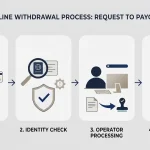
A withdrawal from a casino account is not simply a matter of tapping a button in a mobile app. The amount available to request, the payment route and the operator’s processing stage all affect when funds reach the receiving account. A clear record of the request helps distinguish a pending withdrawal from one that has been sent but is still travelling through the payment system.
Do
- Check the balance available for withdrawal
- Verify the required payment route in the cashier
- Keep a record of the request amount, method, and date
Don’t
- Rely on the total account balance for withdrawals
- Assume a preferred payout method is always available
- Treat a published timing as a fixed deadline
The first check is the balance shown as available for withdrawal, rather than the total displayed in the account. Any amount still subject to conditions is not necessarily withdrawable. Once the available sum is confirmed, the account’s cashier should show which methods can be used and whether a particular route is required. That detail matters: casinos commonly return funds through the same payment channel used to deposit, so a preferred payout method may not be available for every account.
Payment route and timing
Timing depends on both the operator and the payment provider. A specialist review of UK-licensed casinos reported an e-wallet withdrawal through PayPal reaching the account in two hours, while the bank-transfer examples took three to five business days and debit-card withdrawals took one to three business days. These are observations from that review, not guaranteed delivery times for every casino or transaction.
A separate review-based benchmark for e-wallet payouts at UK-licensed operators is processing in under 24 hours. That figure should be read as a reported comparison point, not a promise that every request will be completed within that period. Operator checks and the receiving provider’s own handling can affect the final arrival time. The status shown in the casino account is therefore more useful than treating a published timing as a fixed deadline.
It also helps to separate two stages. An operator may approve and send a withdrawal before a bank or payment service displays the funds. Conversely, a request still marked as pending has not necessarily entered the external payment stage. If the expected timing has passed, the account history and the operator’s stated status provide a starting point for a support enquiry. Keeping the request amount, method and date together makes that enquiry specific.
Foreign Casinos for UK Players: Rules and Risks
What happens after a request
Before confirming a payout, the cashier should be checked for the destination account and method. A mismatch between the chosen route and the one linked to the account can cause confusion or delay. Since the deposit channel is generally also the required withdrawal channel, this is not merely a matter of preference; it is part of how the payment route is assigned.
After submission, the withdrawal should remain a withdrawal unless the customer actively agrees to cancel it. UK-licensed operators are not permitted to put a requested payment back into the gambling balance without that consent. A cancellation option may be presented, but it must not be treated as automatic permission to reverse the transaction. If the request is left in place, the money should not be returned to the playable balance by the operator on its own initiative.
This protection is especially relevant when a payment is pending. A pending label does not itself mean the request has been cancelled, and a customer should be able to see whether the payout remains active. If an account history appears to show the funds returned without an agreed cancellation, the relevant entries and any messages about the request should be retained while the issue is raised with the operator.
Checking a delayed or disputed payout
A delay is not the same thing as a refusal to pay. The first practical distinction is whether the operator has approved the request, is still processing it, or has marked it as rejected. The account’s transaction history can establish the amount, the selected method and the status recorded by the casino. Any explanation from support should be compared with that record, rather than relying on a general estimate for a different payment route.
Disputing a Payout
Step 1: Record transaction details
Collect the requested amount, the date of the request, the payment method, and the status shown in the account.
Step 2: Use internal processes
Raise the issue with the operator using the recorded evidence.
Step 3: Contact ADR body
If internal complaints do not resolve the issue, take the dispute to the operator’s approved alternative dispute resolution body.
If the operator refuses a legitimate withdrawal and its internal complaint process does not resolve the issue, the dispute can be taken to the operator’s approved alternative dispute resolution body. The complaint should set out the requested amount, the date of the request, the payment method, the status shown in the account and the operator’s response. That creates a concise record of what was requested and where the disagreement lies.
For someone choosing a real-money online casino app, payout terms are part of the account decision, not an afterthought once a balance has built up. The useful comparison is between the available withdrawal routes, the processing information the operator provides and the rules that apply after a request is made. A fast payment method is of limited value if it is not eligible for that account; a clear route and a withdrawal that cannot be reversed without consent are more material than a speed claim alone.
Real-Money Play: Limits and Account Controls
A real-money casino app connects play to a gambling account: funds can be deposited, and winnings may be eligible for withdrawal under the operator’s terms. That makes its account controls part of the product, not an optional extra. A free-to-play app may offer casino-style games without real-money stakes, but it does not provide the same financial safeguards because no gambling deposit is being made through it.
Casino Sites Not Registered with GamStop in the UK
In the UK, online gambling is legal only through licensed and regulated sites. Operators serving customers in Great Britain must hold the relevant UK Gambling Commission (UKGC) licence. A UK licence is the strongest consumer protection available in this market, but its value depends on checking that the licence belongs to the operator behind the app. A familiar app-store listing or polished design is not a substitute for that check.
The operator’s UKGC licence number can be found at the bottom of its homepage. The name shown in the app, the website and the licence information should identify the same business. If those details do not line up, the app should not be treated as a verified route to real-money play. The UKGC register provides a way to check licensing status; the relevant question is whether the operator holds a current licence for the gambling activity it offers.
Deposit limits are a central account control. UKGC-licensed operators must provide them, with settings that can be made daily, weekly or monthly. These controls are managed through account settings, although the route to them may differ between apps. The important distinction is between seeing a limit option and having a clear limit set: an unused control does not restrict deposits.
A limit sets a ceiling on deposits over the selected period; it is not a spending target or a guarantee that gambling will remain affordable. Before real-money use, the limit should be considered against the account holder’s budget, with essential costs kept separate. A mobile interface can make a deposit quick, but speed does not alter the amount available to spend. The account setting is the practical point at which a financial boundary can be applied.
Licensing Check
An app’s presence in a store or a polished design is not proof of regulation; always verify the operator’s UK Gambling Commission licence number on their homepage.
Remote operators must prompt new customers to set a financial limit before their first deposit and provide accessible account-level limit controls. That means the first deposit should not be treated as a step that has to happen before controls can be found. If the app directs a new account towards payment but does not present the required limit-setting step, the issue is with the account process, not a reason to bypass the control.
The useful comparison between real-money casino apps is therefore not just how games appear on a phone. It is whether the operator is licensed, whether the limit settings are accessible, and whether the account makes the chosen boundary clear. A real-money casino app for Android follows the same standard as one used on another device: the operating system does not replace the operator’s regulatory obligations. Nor does installation alone prove that the app is operated by a UK-licensed business.
British Casinos Not on GamStop: How Exclusion Works
Free-play access should also be kept separate from a real-money account. A game that can be opened without depositing may help explain its interface, but it does not establish that the operator is licensed to take real-money bets. Conversely, a promotional balance attached to an account may be subject to separate conditions. Those terms affect bonus funds, not the basic role of a deposit limit, and should not be confused with the amount a customer has chosen to keep available for deposits.
A sensible assessment of the best real-money casino app is consequently a check of conditions rather than a ranking based on appearance. Confirm the operator’s UKGC status, locate the limit controls, and identify the period covered by each setting. Daily, weekly and monthly limits measure different windows; the selected one should match the boundary intended for the account. If several settings are available, their effect should be understood before making a deposit.
International Casinos for UK Players: What to Know
Real-money access is not made safer by being native to a phone, nor does an app become regulated because it appears in an official app store. The relevant protections attach to the licensed operator and the account it provides. A current UKGC licence and usable deposit-limit controls are the basic checks; without them, convenience is only a feature of the screen.
Slot Apps and the Rules on Spins
A slots app may put a large spin button within easy reach, but the pace of play is not left entirely to the interface. In Britain, online slot spins must last at least 2.5 seconds, and autoplay is banned. These rules apply to online slots whether they are opened in a mobile app or on a phone’s browser.
The minimum duration is measured per spin. A player cannot start a sequence that automatically runs through successive spins while they watch. Each spin has to be started manually, and the game must take at least 2.5 seconds to complete it. A fast tap or repeated tapping cannot turn that into a shorter permitted cycle.
That distinction matters when assessing a slot machine app. The spin button may be prominent, but a quick response from the button is not the same as a completed spin. The legal minimum concerns the duration of the game cycle, not how quickly the screen registers a touch. Nor does a manual start mean that the outcome can be predicted or controlled.
Slot Rules
In the UK, online slot spins must last at least 2.5 seconds, and the use of autoplay is prohibited.
Autoplay is not a setting to look for in a UK slots app: it is prohibited for online slots in Britain. A feature that starts another spin without a new player action would not fit that rule. Manual play does not remove the need to keep track of the stake and the amount spent; it only means that each spin requires a separate action.
Stake limits are another part of the rules. The maximum stake is £5 per game cycle for adults aged 25 and over. For customers aged 18 to 24, the maximum is £2 per game cycle. The limit applies to each cycle, rather than setting a ceiling on the total amount that can be spent across a session. It is therefore possible for many individually compliant spins to add up to a substantial spend.
The distinction between age groups is important when comparing slots. A game’s displayed maximum stake does not mean that every customer can use that amount. The applicable limit depends on the player’s age, and a lower setting may be necessary to stay within it. The control for changing a stake can differ between games, so the amount shown before a spin is the relevant figure to check.
These restrictions shape what “best” can mean when comparing mobile slots. A title cannot be judged solely by how quickly its button responds or whether it offers automatic play. In Britain, the legal spin duration and the autoplay ban apply across the market; neither is a special feature of one particular slot app. The practical comparison is the game’s stake display, how clearly it shows the amount committed to each spin, and whether the interface makes manual play straightforward.
Casinos That Bypass GamStop: UK Access and Risks
For anyone weighing up a UK slots app, the rules set a fixed baseline: at least 2.5 seconds for each spin, no autoplay, and a stake ceiling determined by age. Anything presented as a way around those limits is not a legitimate advantage.
Casino Games on a Phone
A casino games app is best judged by how clearly it presents play, not by the size of a promotional banner. A mobile casino may offer different kinds of games, but the available selection depends on the operator. A long catalogue is not automatically useful if game descriptions, rules and controls are difficult to locate on a phone screen.
The first practical check is whether a game is understandable before money is committed. Its rules, stake controls and any relevant paytable should be accessible from the game itself. Small text or controls that are easy to mistake can make a familiar format harder to use. The interface is part of the experience; it does not change the underlying terms of play.
A casino game app may also place several types of entertainment together. That does not make their rules interchangeable. Each game has its own instructions and decisions, so the useful comparison is whether those details are available and readable, rather than whether the app presents everything in one menu. A mobile casino games catalogue is most informative when categories are clear and the descriptions do not blur one format into another.
Choosing an App
The best casino app is determined by the operator’s licensing status, clear game information, and legible controls rather than a universal ranking.
“Best” is therefore a question of fit, not a universal ranking. A best casino game app for one person may be a poor choice for another if its navigation, presentation or selection does not match what that person wants to play. The same applies to slot games: a slot game app is only one part of a broader casino offering, and slot-specific rules remain separate from the experience of other games. A list of titles alone cannot establish that an app is better.
The legal baseline still applies on a phone. Online gambling in the UK is legal at licensed and regulated sites, and operators serving Great Britain customers must hold the relevant UK Gambling Commission licence. A polished screen does not substitute for that status.
The sensible assessment is narrow: check that game information is legible, controls are clear, and the operator is licensed for the market. Then compare the actual games offered with the intended style of play. That is a more useful test of a mobile casino than a claim that one app is simply the best.
Free Spins and Bonus Terms: The Final Payout Calculation
A casino app free-spins offer is not measured by the number of spins alone. The relevant figure is the amount that remains withdrawable after wagering requirements, eligible-game rules and any cashout cap have been applied. A free casino app or free slots app may also provide play that has no cash value; that is separate from a bonus whose winnings can become withdrawable under stated conditions.
Non-GamStop European Casinos: UK Rules Explained
A specialist review of bonus terms reports wagering requirements in the 35x to 40x range. The calculation is based on the bonus amount: a requirement of 35x means eligible stakes totalling 35 times that bonus, while 40x means 40 times. It is not the amount of winnings required. The offer’s wording determines which games count and whether different games contribute at different rates. A roulette session, for instance, should not be assumed to clear the same amount of wagering as slot play unless the terms say so.
The same review type reports that bonus offers can restrict the maximum bet while wagering is active, and that game weighting can affect progress. A maximum cashout can then limit the amount left to withdraw even after the requirement is met. Specialist bonus reviews report caps in the £100 to £200 range; that is an observed range, not a promise that a particular offer uses either figure. The actual cap and what it applies to must be read in the offer terms.
Deadlines change the calculation too. Specialist reviews describe wagering periods ranging from 7 to 14 days, with some offers allowing only 72 hours. A balance that has not met the requirement before the stated expiry may not qualify for withdrawal. The deadline, eligible games, maximum stake and cashout cap therefore belong in the same calculation, not in separate checks after accepting an offer.
Bonus Terms
Attention: A large bonus value can be offset by high wagering requirements, short deadlines, or low maximum cashout caps.
For casino apps with free spins, the useful comparison is the final permitted cashout, not the headline spin count or bonus value. A larger bonus can require substantially more eligible wagering; a short deadline or low cashout cap can reduce its practical value further. The terms should state whether winnings from spins are subject to wagering and how they are treated once credited. If those conditions are unclear, the advertised amount cannot be treated as a reliable estimate of a payable balance.
Some links on this page are affiliate links. Wino may receive payment if a reader clicks a link and deposits.
Casino Apps on Android
An Android casino app is not automatically the best choice simply because it can be installed on a phone. The useful comparison is between the operator’s terms, the app’s stated requirements and the way its account functions fit the intended use. Without those details, a broad claim that one Android app works best in the UK has little practical value.
Availability should be checked through the operator’s own website or its official app-store listing. The listing should identify the operator and explain which Android versions and devices it supports. If the phone falls outside those stated requirements, performance cannot be assumed. An app advertised on an unfamiliar download page also needs extra scrutiny: a familiar logo is not proof that the file comes from the operator.
Before installation, the account terms matter more than the app’s appearance. Check the operator’s UK licence, the rules for deposits and withdrawals, and the account controls available in the app. A mobile interface does not change the underlying conditions. Any difference between the app’s promotional wording and the full terms is a financial difference, not a design detail.
Best Offshore Casino Sites: UK Rules and Risks
Permissions deserve the same attention as the terms. The requested access should make sense for the app’s stated functions. A request that is unrelated to account access or ordinary operation is a reason to pause and verify the app’s source before proceeding. Updates should also come through the official channel, rather than a file supplied through an unsolicited message or an unofficial download site.
The phrase “best app for slots” can obscure a separate question: whether the app supports the device and whether its terms suit the intended play. Slot rules apply regardless of whether the game is opened on Android or another platform. The app itself does not remove those rules, and a polished interface does not improve the value of an offer.
Android and iPhone apps should not be treated as interchangeable downloads. Each must be checked against the relevant device’s requirements and the operator’s own instructions. A casino that offers an app for one platform may present a different route on another; availability should be confirmed rather than inferred from a shared brand name.
For playing on the go, the sensible comparison is therefore specific: official source, stated device support, clear account terms and accessible controls. If any of these cannot be confirmed before installation, the app has not earned a place on a shortlist.
Live Dealer Games on Mobile
Live dealer play brings a streamed table and a human presenter to a phone screen. It differs from a standard digital casino game because the round is conducted on camera, while the player’s choices are submitted through on-screen controls. A live dealer casino app is therefore not simply a catalogue of games: the viewing area, table information and controls have to share a small display.
Evaluating Live Dealer Interfaces
Check if the viewing area, table information, and controls share the small display legibly. Assess whether the current action, available choices, and table details remain clear without excessive scrolling or switching panels.
The practical question is whether the layout keeps those parts legible at the same time. A compressed video window may leave more room for controls, but less room to follow the table. A larger video view can improve visibility while requiring more scrolling or switching between panels. Neither layout is automatically better; the useful measure is whether the current action, available choices and relevant table details remain clear during play.
Live dealer games can be available through a mobile casino app where the operator offers them. The range and interface depend on that operator, so the phrase “best live dealer casino app” has no useful meaning without checking what is actually available and how it is presented. A named table or provider should not be assumed to appear in every app. The same applies to claims about an app loading fastest: speed can vary with the device, connection and service conditions, rather than being a fixed quality of the game category.
For a comparison, inspect the live section itself rather than relying on a general app description. Check whether the table view fits the screen, whether the controls are easy to distinguish from the video, and whether the game rules are accessible before joining. Also note whether the interface makes the current table state apparent. These are functional details, not decorative ones: if a control or instruction is hard to locate, the streamed presentation does not compensate.
A mobile app may combine live dealer tables with slots and other casino games, but that does not make their formats interchangeable. Live play depends on following a presented table and submitting choices within its interface. The relevant assessment is therefore the clarity of that process on the phone, not the number of game categories shown on the app’s home screen.
Casino Sites and Safety: Licensing and Access · Online casino no registration in the UK: what it means
Deposits on iOS and Bingo Apps
An iPhone or iPad does not determine which deposit methods a mobile casino accepts; the options are set by the operator. Apple Pay may appear in an iOS cashier, while card, e-wallet and Pay by Phone availability varies. A bingo app follows the same practical rule: check its cashier before treating a payment method as available.
A specialist review of tested apps reported that Apple Pay deposits were credited instantly and could be completed in two taps. That is a reported result, not a timing guarantee for every app or payment. Debit-card deposits were also described as generally instant in a specialist review, although a bank may flag a gambling transaction and delay or decline it. Credit cards cannot be used to fund gambling in Britain, including through a money service business or a wallet carrying credit-card funds.
Minimums need checking before entering payment details. A specialist review reported that most apps set a £5 minimum deposit, with some allowing £2. These are reported figures, not fixed market rules; the cashier’s displayed minimum governs the transaction.
Non-UK-Registered Casinos: Licensing Explained
Pay by Phone charges the deposit to a mobile account rather than a bank card. A specialist review reported that many operators cap this method at £30 per transaction. Some networks may add a premium-rate fee of £0.50 to £1.50, according to that same type of review. The casino deposit can therefore cost more than the amount selected. The charge appears on the next phone bill or is deducted from pay-as-you-go credit, so the payment is not separate from ordinary mobile spending.
An offer described as a no-deposit casino app concerns the promotion, not a deposit route. It does not establish that an app is available for iOS or iPad, or that a bingo product is included. For any app that does accept deposits, the useful comparison is the amount charged, the minimum accepted, and whether an extra network fee applies—not the speed suggested by a payment logo.
How long should a mobile casino withdrawal take in 2026?
For UK-licensed operators, e-wallet withdrawals should realistically take under 24 hours. Bank transfers typically take 3–5 business days, while debit card withdrawals take 1–3 business days.
Are there any fees for using phone credit?
Some mobile networks charge a premium-rate fee, usually £0.50 to £1.50, for pay-by-phone deposits. The charge is added to your next phone bill or deducted from your pay-as-you-go credit.
Can I set deposit limits on mobile?
Yes. UK-licensed operators must offer deposit limits, which you can set daily, weekly or monthly in your account settings.
Which bonus terms most commonly block withdrawals?
Wagering requirements, maximum bet limits, game weighting and maximum cashout caps can restrict bonus withdrawals. Typical wagering requirements are 35x to 40x the bonus, and many offers cap winnings at £100 to £200.
How fast are withdrawals on these apps?
E-wallet withdrawals should realistically be under 24 hours for UK-licensed operators; the fastest observed PayPal withdrawal took 2 hours. Bank transfers typically take 3–5 business days, and debit card withdrawals take 1–3 business days.
Casino Sites

Anjouan Casino Licence in the UK: What It Means
Anjouan licensing has a limited territorial scope and does not meet the UK authorisation requirement...

Foreign Casinos for UK Players: Rules and Risks
The guide explains licensing status, bonus conditions, payment checks, withdrawal routes and protections that may...

International Casinos for UK Players: What to Know
The guide distinguishes UKGC authorisation from offshore licensing and examines access, payouts, bonus terms, crypto...

UK Mobile Casinos That Accept Phone-Credit Payments
Phone-credit deposits run through a network account or prepaid balance, distinct from using a mobile...

Best Offshore Casino Sites: UK Rules and Risks
A practical guide to UK licensing, payment and bonus conditions, identity checks, and risks that...

Best Offshore Casinos for UK Players: What to Check
Offshore casinos may accept UK customers without UKGC approval, leaving players outside some protections of...

British Casinos Not on GamStop: How Exclusion Works
GamStop exclusions apply to participating UKGC-licensed establishments, while other sites may operate outside that framework...

Casino Sites Not Registered with GamStop in the UK
See how UKGC licensing defines GamStop’s reach and what to consider when assessing casinos outside...

Casino No ID Verification in the UK: What It Means
A practical explanation of sign-up, play and payment checks, including why “no ID” claims do...

No ID Verification Withdrawal Casinos in the UK
The phrase “no ID verification” can describe delayed checks, while UK gambling businesses must verify...

Casino Without a UK Licence: Rules and Risks
A foreign licence does not mean UKGC oversight, and the difference can affect player protections,...

Casinos That Bypass GamStop: UK Access and Risks
The guide distinguishes UK self-exclusion protections from offshore licensing, access and bonus conditions. What a...

Curacao Casino Licences and UK Player Protections
A licence identifies a regulatory framework, but does not show whether a casino accepts UK...

Gibraltar Casino Licence in the UK: What It Means
A Gibraltar licence identifies the operator’s regulator, while UK-facing service in Great Britain requires separate...

Jackpot Mobile Casinos in the UK: Pool Rules
Jackpot games can use different pool structures, so the prize amount alone does not explain...

Merkur Casino Online UK: Games, Login and Checks
Merkur games, casino branding and account access can refer to different things, so operator status...

Most Trustworthy Online Casinos in the UK: Licence Rules
A practical framework for checking licensing, market boundaries, bonus terms and verification before assessing a...

No Account Casino UK: How It Works and What to Check
A no-account label can mean a shorter sign-up journey, but it does not remove identity...

Non-Gamban Casinos in the UK: What It Means
Gamban is a blocking service; GAMSTOP applies self-exclusion across participating licensed gambling websites and apps...

Non-GamStop Curaçao Casinos and UK Rules
A Curaçao licence claim, permission to serve Great Britain and participation in UK self-exclusion arrangements...

Non-GamStop European Casinos: UK Rules Explained
The “Non-GamStop” label describes a site outside the scheme, but does not establish its licence...

Non-UK Licence Casinos: What the Licence Means
Licensing jurisdiction, verification rules and withdrawal terms shape what oversight and player recourse may apply....

Non-UK-Registered Casinos: Licensing Explained
A foreign licence is not UKGC approval, and differences in rules can affect access, payments,...

Non-UK-Regulated Casinos: Rules and Protections
The guide distinguishes UKGC oversight from licences issued elsewhere and outlines the limits of player...

Non-UKGC Licensed Casinos: Rules and Risks
A guide to the difference between UKGC authorisation and offshore licences, including bonus conditions, payment...

Malta MGA Licence for UK Online Casinos: What Applies
A Malta operating licence is separate from permission to offer remote real-money gambling in England,...

Online casino no registration in the UK: what it means
Browser access can remove software installation, but it does not establish that an account or...

Online Casinos with No Sister Sites in the UK
Sister-site relationships can stem from common ownership or connected core technology; a similar look alone...

Online Slots Not on GamStop: Rules and Limits
GamStop exclusion is tied to participating UKGC-licensed operators, not to a particular slot, studio or...

Safe Online Casinos in the UK: Licence Checks
A practical guide to licence checks, bonus terms, account safeguards, payment steps and the limits...

Online Casino Payouts in the UK: How RTP Works
Understand how game returns, volatility, licensing and withdrawal timing shape casino payout claims. What an...

Trusted Casinos Not on GamStop UK: What to Know
A practical look at how non-UK casinos’ licensing, exclusion arrangements, payment terms and player safeguards...

Trusted UK Casino Checks: Licence, Offers and Payouts
A practical framework for checking who provides the gambling service, how safeguards work, and what...

USA Casinos for UK Players: Legal Status and Risks
The guide separates operator licensing from player liability and examines the practical terms and risks...

VPN-Friendly Casinos in the UK: What the Label Means
The guide explains how casino terms, UK consumer protections, privacy, verification and withdrawals relate to...